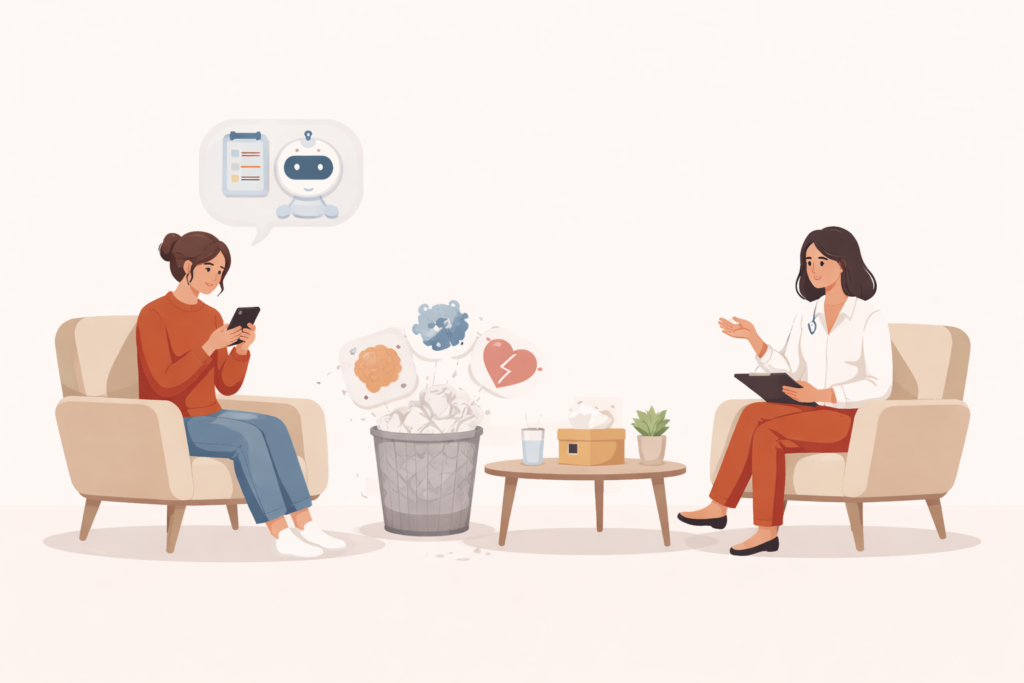
A growing shift in therapy today is this: Many clients now walk into sessions after asking AI what is wrong, what trauma they have, what attachment style they are, and which therapy technique should “fix” them.
They arrive with labels. They arrive with scripts. They arrive with treatment plans written by a machine that has never sat with their silence. This is not always a bad thing.
Sometimes AI helps people name emotions, seek support sooner, and feel less alone. That matters. But here is where it gets complicated. Healing is not a recipe card.
Two people can have the same anxiety symptoms and need completely different therapeutic approaches. One may need emotional regulation. Another may need grief work. Another may need trauma informed pacing. Another may need a medical referral first.
AI can identify patterns. A therapist identifies people. That difference is everything. As therapists, we now need to gently unpack certainty that clients bring into the room. Not dismiss it. Not shame it. Not compete with it. But widen it.
We help clients move from: “AI said CBT is best for me.”
To: “Let us understand what you need, not just what fits a data pattern.”
We help them see that insight is not the same as integration. Information is not transformation. And self diagnosis can become another form of avoidance. The future of therapy is not therapist versus AI. It is therapists using human judgment, attunement, ethics, timing, and relational depth in a world flooded with instant answers.
Because sometimes the right intervention is not the smartest one. It is the one the nervous system can actually receive. That part still requires a human in the room.
Leave a Reply